Guide · Garage & car park
Underground car park cleaning: how wet cleaning works – and what it costs
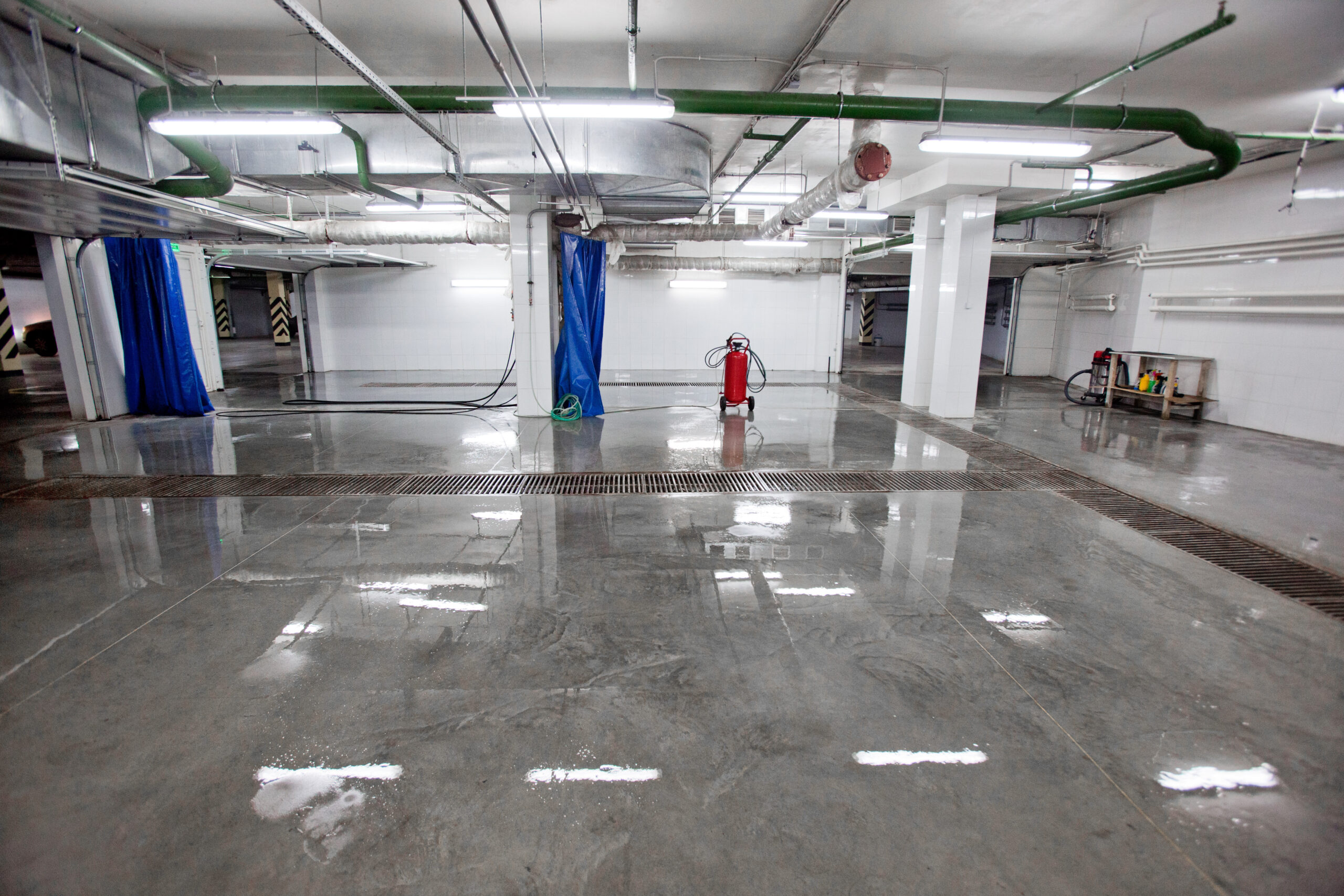
In short: Underground car park cleaning should include a machine wet clean at least once a year – ideally in spring, after the last frost. Regular sweeping is enough in between. The main reason is not appearance but road salt: chlorides attack concrete and the steel reinforcement inside it. For one-off jobs our hourly rate starts at €50 net; regular weekly cleaning starts at €41.20 net per hour.
What is underground car park cleaning?
Underground car park cleaning covers the driving lanes, parking bays, ramps, entrances and exits, stairwells and technical side areas of a garage. There are three levels:
- Dry cleaning (sweeping): a sweeper-vacuum machine picks up sand, grit, leaves and paper. This is routine care – monthly or quarterly, depending on traffic.
- Wet cleaning: a scrubber-dryer applies water and detergent, brushes the floor and immediately vacuums the dirty water back up. Dissolved salt and oil film are removed instead of being spread around.
- Special cleaning: pre-treating oil stains, washing walls and pillars, clearing drainage channels and silt traps, cleaning signs and lights.
For a small private garage with three spaces, a broom is often enough. From a residential complex with a shared garage, an office building or a supermarket car park upwards, only a machine makes sense – by hand the area can be done neither economically nor thoroughly.
Why an underground car park needs cleaning
Road salt destroys concrete
In winter, every car brings slush and de-icing salt into the garage. The water evaporates, the salt stays. Dissolved chlorides penetrate the concrete and can make the steel reinforcement rust. Rust takes up more space than steel, so the concrete spalls – visible as chipped edges at the base of pillars and on ramps. A wet clean in spring removes the salt before it penetrates deeper. It does not replace a coating or a structural inspection, but it extends their effect.
Slip hazard and liability
Oil film, wet leaves and fine sludge make ramps and walkways slippery. Whoever operates a garage – a property manager, an owners’ association or a company – has to keep traffic routes safe. A clean, well-lit car park is the simplest way to prevent falls.
Drainage and oil separators
According to Wien Kanal, the City of Vienna’s sewer operator, oil separators are installed in garages, among other places, to hold back hydrocarbons. Blocked channels and full silt traps cause puddles and put strain on the separator. When we clean, we make sure coarse dirt is picked up first and not flushed into the drainage. Servicing and emptying the separator itself is a job for a specialist firm – it belongs in the property manager’s maintenance plan.
First impressions
For many tenants and customers, the garage is the first room they enter. Black tyre marks, cobwebs on the ceiling and an overflowing bin by the lift shape their impression of the whole building.
How is an underground car park cleaned?
The order of work determines the result. The rule of every professional clean applies: top to bottom and clean to dirty – in a garage that also means from the inside out, towards the exit and the drains.
- Preparation: a notice to all users at least a week in advance, sections defined, bays cleared section by section. Without empty bays, the job stays patchy.
- Start at the top: remove cobwebs from the ceiling and pipes, dust lights, signs and fire extinguisher cabinets. Whatever falls down is then picked up by the machine.
- Remove coarse dirt: leaves, paper and sand with the sweeper, corners and edges by hand. Clear channels and silt traps.
- Pre-treat: let oil stains soak with a suitable alkaline cleaner. Contact time matters more than force – scrubbing without it only spreads the stain.
- Wet clean: scrubber-dryer in overlapping lanes, ramps downhill, dirty water vacuumed up immediately. High pressure only where the machine cannot reach – and never on joints or coatings that cannot take it.
- Walls, pillars, stairs: wash impact guards and pillar bases, damp-mop entrances and stairwells, clean door handles and lift buttons.
- Inspection and handover: joint walk-through, photos, bays released again.
Products: for driving lanes an alkaline garage cleaner that dissolves oil and tyre rubber; for lime and salt rims, if needed, a mildly acidic cleaner – but never both at the same time and never on sensitive, uncoated stone without a test. For coated floors, the coating manufacturer specifies the products.
How working with us runs
Enquiry: you send us photos, the approximate area or number of bays and your preferred period. Site visit: we check floor, coating, drainage, entrance height and water supply – on site or by video call. Fixed price: you get in writing what will be done, in which sections and at what price. Start: a fixed team works to the agreed plan, at weekends or at night if you wish, so that as few cars as possible have to be moved.
What does underground car park cleaning cost?
The price depends less on the city than on the condition, how accessible the areas are and how many bays are actually free. Our hourly rate is the same at all locations; what differs is travel time, which we count as working time. The following figures are net guide values for a machine wet clean of a garage with around 40 bays (about 1,000 to 1,200 m²) in normal condition:
| City | One-off hourly rate | Typical effort | Guide value total | What matters there |
|---|---|---|---|---|
| Vienna | from €50 net | 6–9 hours | approx. €300–450 + travel time | many older garages with low entrances – check machine size first |
| Graz | from €50 net | 6–9 hours | approx. €300–450 + travel time | often grit from winter service – sweep thoroughly first |
| Linz | from €50 net | 6–9 hours | approx. €300–450 + travel time | company and multi-storey car parks: plan cleaning for off-peak hours |
| Salzburg | from €50 net | 6–9 hours | approx. €300–450 + travel time | snowy winters – a lot of salt, so the spring wet clean matters most |
It gets more expensive with heavy oil contamination, with blocked areas that have to be revisited, or if walls and ceilings are included. It gets cheaper if the garage is empty and the cleaning is combined with other work in the building. We give you the exact figure in writing – the site visit turns it into a fixed price. More about the service on our page garage cleaning Vienna, and for the other cities Graz, Linz and Salzburg.
Typical mistakes
- Just hosing down: water without extraction pushes salt and oil into joints and channels and leaves puddles behind. Dirty water has to be picked up.
- No notice: if half the cars stay, half the area is not cleaned. A notice and clear sections are a must.
- High pressure on coatings: too much pressure from too close can damage coatings and joints.
- Wrong product: acidic cleaners on concrete without a test, or alkaline and acidic products mixed – harmful to the floor and to health.
- Cleaning in winter but not afterwards: clean in January and you will have salt again by March. The best date is after the last frost period.
- Forgetting the drainage: full silt traps undo every clean.

Fee says: A car park forgives a lot – but not road salt that sits there all winter. Sweep in late autumn, wet-clean in spring, and you will rarely need a concrete repair contractor.Sie machen Dreck – wir machen’s weg. (You make the mess – we make it go away.)
Checklist before car park cleaning
- Date chosen after winter, alternative date agreed
- Notice put up at least seven days in advance, with sections and times
- Entrance height, water and power supply clarified
- Floor type known: bare concrete, coated, mastic asphalt
- Oil stains and problem areas photographed
- Silt traps and channels accessible
- Oil separator service date checked with the property manager
- Handover walk-through with photos agreed
Frequently asked questions about car park cleaning
How often should an underground car park be cleaned?
Sweeping monthly to quarterly depending on traffic, and a machine wet clean at least once a year – ideally in spring, when no more salt is carried in. Heavily used garages of supermarkets or office buildings need wet cleaning more often.
What does underground car park cleaning cost?
We charge one-off jobs from €50 net per hour according to effort; travel time there and back counts. For around 40 bays in normal condition the guide value is about €300 to €450 net plus travel time. Regular weekly cleaning costs from €41.20 net per hour as a monthly flat rate.
Do all cars have to leave the garage?
Not at the same time. We clean in sections; users only clear their section at the stated time. A notice at least a week in advance is essential.
Can the dirty water go into the sewer?
Garages are usually connected to oil separators. We pick up the dirty water with the scrubber-dryer instead of flushing it into channels. Questions about discharge go to the operator of the facility; in Vienna, Wien Kanal provides information.
Can oil stains be removed completely?
Fresh stains usually come out well. Old stains that have soaked deep into bare concrete get lighter but do not always disappear completely. We tell you this before you place the order.
Do you also clean at weekends?
Yes, at weekends, early in the morning or at night if you wish – so that as few vehicles as possible have to be moved.
Garage after winter? Send us photos and the number of bays – you get a figure in writing, and the site visit turns it into a fixed price.
Request a quote →Sources: oil separators and indirect discharge: City of Vienna – Wien Kanal glossary (German), accessed 11/2026. Prices and services: bling-bling.at/en/garage-cleaning-vienna (net, as of 11/2026). Effort and example are guide values based on freely chosen assumptions.
More guides: waste room cleaning · sofa cleaning · limescale and urine scale