Guide · Building & property management
Waste room cleaning: how the smell disappears – and what regular care costs
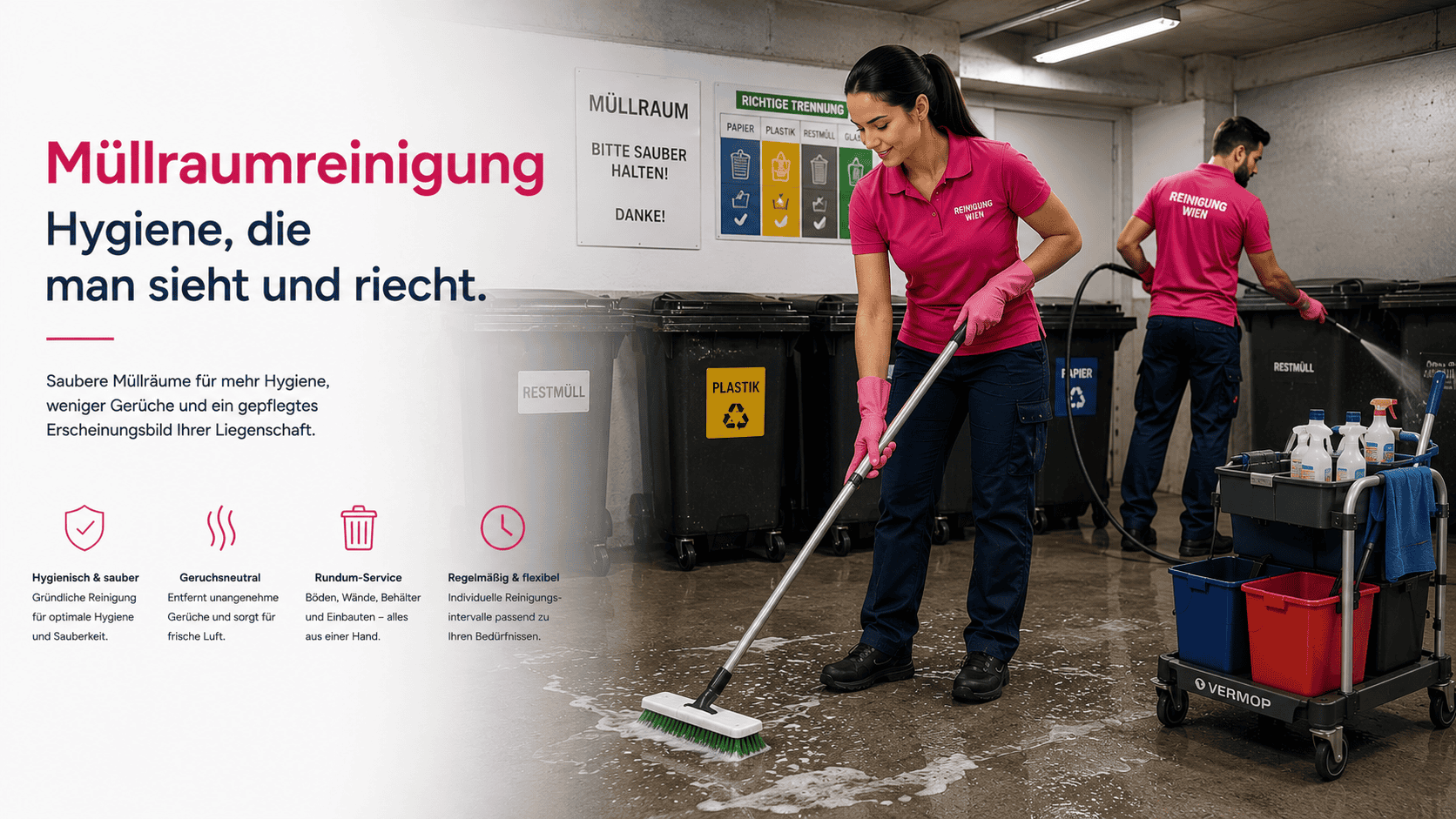
In short: Waste room cleaning has two parts: routine care (sweeping, mopping, wiping the outside of the bins – usually weekly as part of property care) and a deep clean with bin washing and disinfection (two to four times a year, more often in summer). The best time is straight after collection, when the containers are empty. Routine care costs from €41.20 net per hour as a monthly flat rate; one-off deep cleans from €50 net per hour.
What is waste room cleaning?
The waste room – in Viennese residential buildings often a room on the ground floor, in the courtyard or in the basement – is where the residual, organic, paper and plastic bins stand. Waste room cleaning covers the room itself and the containers:
- Room: floor, skirting, walls up to hand height, doors, door handles, light switches, ventilation grilles, floor drain.
- Containers: lids, handles, outsides and – during the deep clean – the inside of the empty bins.
- Hygiene: disinfection of contact surfaces and odour treatment that removes causes instead of masking them.
Removing bulky waste left in the bin room is not part of it. That is a clearance and is agreed separately – see the typical mistakes below.
Why the waste room needs regular cleaning
Odour
The typical bin room smell comes from liquids dripping from bags, residue on bin rims and organic waste stuck to the bottom of containers. Bacteria break these residues down, and in warm weather this happens fast. Sweeping the floor alone does not remove the source.
Pests
Flies like to lay eggs on damp organic residue; in summer you then find maggots on bin rims. Cockroaches and rodents are attracted by food scraps. A clean, dry waste room simply offers them less. With an existing infestation, a pest controller is needed as well – cleaning alone is not enough.
Quality of living and service charges
Every household enters the waste room several times a week. It shapes how residents see their building and their property manager. For rented buildings fully covered by the Austrian Tenancy Act (MRG): according to § 21 MRG, property care (no. 8 in conjunction with § 23 MRG) is among the operating costs that can be passed on to tenants. Which services can be charged in an individual case is clarified by the property manager – this is not legal advice.
Safety
Dumped boxes, old furniture or electrical appliances block paths and are a fire load. A tidy waste room is also a safer room.
How is a waste room cleaned?
The order follows the basic rules of every professional clean: top to bottom and clean to dirty. In the bin room that means: first the surfaces people touch, then the walls, the floor last – and the containers outside the room so that dirty water does not run across the freshly cleaned floor.
- Date after collection: only empty bins can be cleaned inside. We schedule the job for collection day.
- Clear out: all containers out onto an area with a drain, loose waste and bags picked up.
- Start at the top: cobwebs, ventilation grilles and lights, then doors, handles and light switches damp-cleaned.
- Walls and skirting: splashes up to hand height washed off with a degreasing cleaner.
- Floor: apply cleaner, allow contact time, scrub, pick up dirty water. Clear the floor drain.
- Bins: clean inside and outside with hot water and a brush or high pressure, lids and handles especially thoroughly, then leave upside down to drain.
- Disinfect: treat contact surfaces – handles, lids, door handles – with a suitable disinfectant and keep to the stated contact time.
- Dry and return: air the room, put the bins back dry, check the waste stream labels.
Products: an alkaline, degreasing cleaner for floor, walls and bins, a disinfectant for contact surfaces and, for stubborn odours, an enzymatic odour remover that breaks down organic residue. Fragrance sprays only mask. Never mix cleaners and disinfectants – clean first, then disinfect.
How working with us runs
Enquiry: you tell us the address, number of containers and collection days and send a few photos. Site visit: we check water supply, drainage, access and condition – often together with stairwell and garage. Fixed price: you get in writing what is done weekly and when the deep cleans take place. Start: a fixed team looks after the waste room on fixed dates, matched to collection.
What does waste room cleaning cost?
The hourly rate is the same at all our locations; differences come from the number of containers, their condition and travel time, which counts as working time. The waste room is cheapest as part of regular property care, because there is no separate trip. Net guide values for a residential building with about 20 households and 8 to 10 containers:
| City | Routine care (0.5 h/week) | Deep clean with bin washing | What matters there |
|---|---|---|---|
| Vienna | approx. €89 per month | 2–4 h, approx. €100–200 + travel time | many bin rooms in old basements and courtyards: check drain and ventilation first |
| Graz | approx. €89 per month | 2–4 h, approx. €100–200 + travel time | schedule on collection day so the organic bin is empty |
| Linz | approx. €89 per month | 2–4 h, approx. €100–200 + travel time | commercial sites with skips: include the container area |
| Salzburg | approx. €89 per month | 2–4 h, approx. €100–200 + travel time | tourism businesses in season: plan shorter intervals |
Heavily soiled old residue, organic waste stuck in many bins or dumped bulky waste mean more effort. Details on the service are on our page waste room cleaning Vienna and for Graz, Linz and Salzburg.
How often should a waste room be cleaned?
| Task | Interval |
|---|---|
| sweep, damp-mop, pick up loose waste | weekly |
| wipe bin exteriors, lids and handles | weekly |
| wash bins inside, disinfect contact surfaces | May to September every 2–4 weeks, otherwise quarterly |
| deep clean of the room incl. walls and drain | two to four times a year |
Waste rooms in businesses, restaurants and offices
Businesses are often held to stricter standards than residential buildings. Restaurants produce large amounts of food waste and grease every day; kitchen waste attracts pests particularly quickly, and food inspections look at the waste area too. Shorter intervals for bin washing and disinfection are usual here, often weekly in summer. In office buildings the waste room is usually cleaner, but it holds a lot of waste paper and cardboard – a fire load that has to be kept in order and collected regularly. In supermarkets and commercial sites with skips, the outdoor container area belongs to the job: spilled liquids collect there and reach the drainage when it rains. For every business, a written cleaning plan with intervals, products and records makes any inspection easier.
Typical mistakes
- Fragrance spray instead of cleaning: perfume over the smell of decay makes an even worse mix. The source has to go.
- Hosing bins inside the room: dirty water runs across the floor and into the corners. Bins are washed outside.
- Cleaning before collection: full bins can only be cleaned on the outside. Schedule for collection day.
- Mixing cleaner and disinfectant: this weakens the effect and can produce dangerous fumes.
- Tolerating bulky waste: one dumped sofa invites the next. A notice, clear rules and quick removal help.
- Forgetting the drain: a blocked floor drain keeps water in the room – and the smell.

Fee says: A bin room does not smell because of the rubbish, but because of what the bins leave behind on the outside and on the floor. Perfume covers it for two days – cleaning and disinfection solve it.Sie machen Dreck – wir machen’s weg. (You make the mess – we make it go away.)
Checklist for a clean waste room
- collection days of all waste streams noted, cleaning planned afterwards
- water supply and an area with a drain available for bin washing
- ventilation clear, grilles clean
- container labels legible, recycling notice up to date
- no bulky waste, no boxes outside the bins
- floor drain clear, floor dry
- pest controller informed if there are signs of pests
- cleaning record with date on the door or digital
Frequently asked questions about waste room cleaning
How often should a waste room be cleaned?
Sweeping, mopping and wiping bin exteriors weekly. Washing the inside of bins every two to four weeks in summer, otherwise quarterly. A deep clean of the room two to four times a year.
What does waste room cleaning cost?
Routine care from €41.20 net per hour as a monthly flat rate – with half an hour per week around €89 net per month. One-off deep cleans from €50 net per hour according to effort, with about 8 to 10 bins usually two to four hours plus travel time.
What helps against bad smells in the bin room?
Remove the cause: wash bins inside, clean floor and walls with a degreasing cleaner, disinfect contact surfaces, ventilate well. For stubborn odours an enzymatic odour remover helps. Fragrance sprays only mask.
Who pays for waste room cleaning in a rented building?
In many buildings it is part of property care, which can count as operating costs under §§ 21 and 23 of the Austrian Tenancy Act (MRG). What is passed on in an individual case is decided by the property manager.
Do you also remove bulky waste from the bin room?
That is not cleaning but a clearance. We agree it separately.
Is cleaning enough for rats or cockroaches?
No. With an infestation a pest controller must come. Cleaning and order prevent the infestation from returning.
Bin room you can smell from the stairwell? Send us photos and the number of bins – you get a figure in writing, and the site visit turns it into a fixed price.
Request a quote →Sources: operating costs and property care: Austrian Tenancy Act (MRG), RIS – Federal Legal Information System (German), §§ 21 and 23, accessed 11/2026. Prices and services: bling-bling.at/en/waste-room-cleaning-vienna (net, as of 11/2026). Effort and example are guide values based on freely chosen assumptions.
More guides: underground car park cleaning · sofa cleaning · limescale and urine scale