
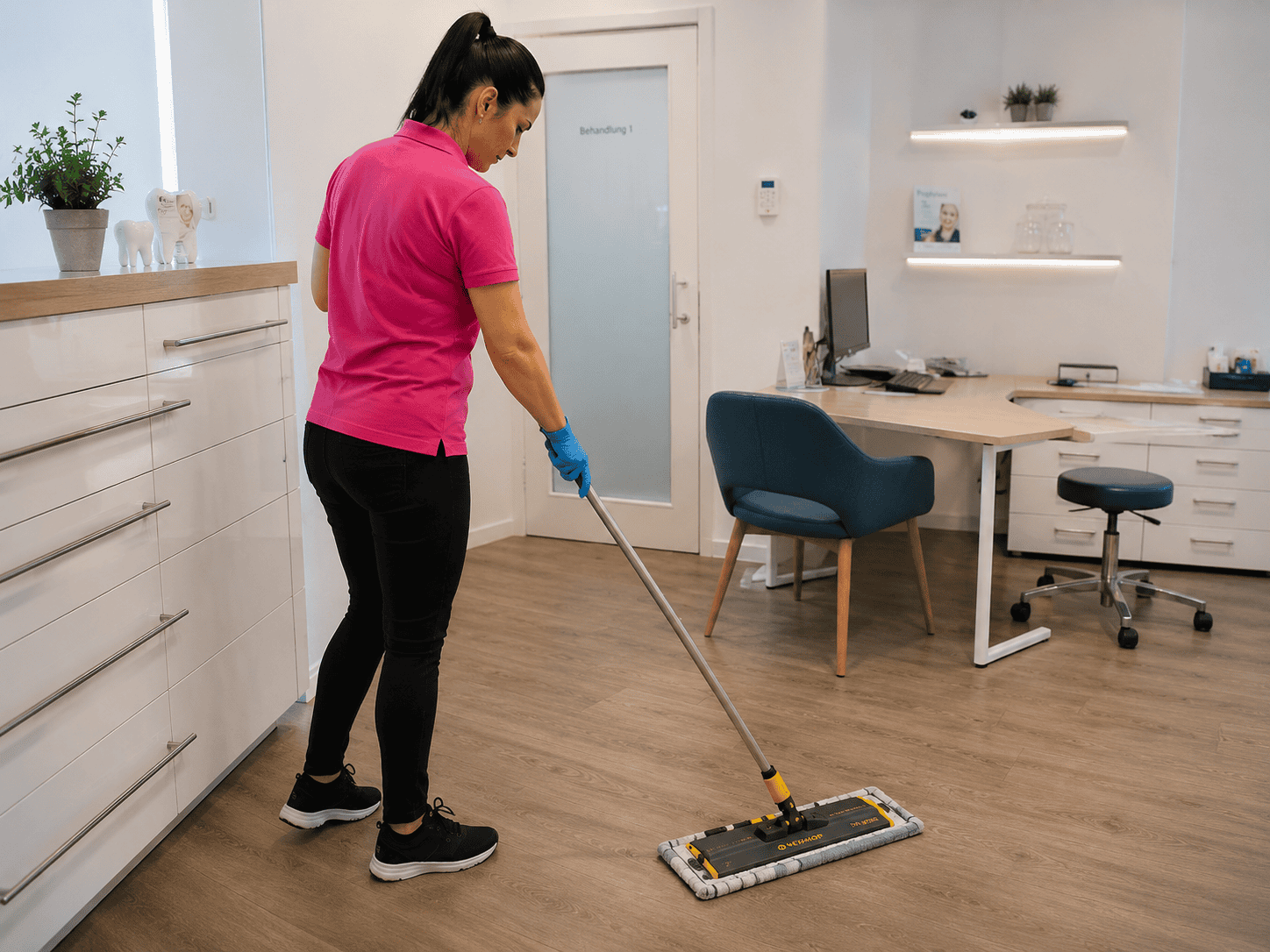
A medical practice cleaning checklist only works if it is part of a written hygiene plan that states who cleans or disinfects which surface, when, with which product and how – and how that is recorded. In Austria, the hygiene regulation of the Austrian Medical Chamber requires every practice to keep a hygiene, cleaning and waste disposal plan, and hygiene is also looked at during the quality evaluation carried out by ÖQMed. This guide explains how to set up a plan that works in daily practice, the difference between cleaning and disinfection, how each area is handled and what ongoing practice cleaning typically costs.
What is a hygiene plan for a medical practice?
Think of it as the framework behind every medical practice cleaning checklist.
The hygiene plan is the core working document for cleanliness and infection prevention in a doctor’s surgery. It turns general requirements into concrete tasks that everyone on the team can follow – from the practice assistants to an external cleaning crew. A tried and tested structure answers five questions:
| Question | What the plan specifies | Example |
|---|---|---|
| Who? | Responsible person or role | practice assistant, doctor, cleaning team |
| What? | Item or surface | examination couch, door handles, floor, toilet |
| When? | Frequency and trigger | after every patient, daily, weekly, after contamination |
| With what? | Product, dilution, contact time, equipment | listed surface disinfectant, red cloth, disposable gloves |
| How? | Method and sequence | wipe disinfection, clean to dirty, do not dry the surface off |
The plan is completed by a disposal plan for medical waste, rules on hand hygiene and – wherever reusable instruments are used – written procedures for reprocessing them. On its hygiene page, ÖQMed (the Austrian Medical Chamber’s quality assurance organisation) provides the 2014 hygiene regulation with its annexes as well as non-binding templates for hygiene, cleaning and disinfection plans. These templates are in German and are a good starting point, but they have to be adapted to your own rooms and services. According to ÖQMed, responsibilities and procedures should always be documented with a date and signature.
Cleaning vs. disinfection: what is the difference?
The two terms are often used interchangeably, yet they describe different goals:
- Cleaning removes visible and invisible soiling, dust, grease and organic residues such as blood or secretions. A large share of microorganisms is removed mechanically along with the dirt.
- Disinfection deliberately reduces pathogens on a surface to the point where, after the contact time, it should no longer pose a risk of infection. This requires a suitable product at the correct concentration and the contact time stated by the manufacturer.
The two belong together. A disinfectant works less well on a heavily soiled surface, because protein and dirt can bind the active ingredients. Visible soiling is therefore removed first and the surface is disinfected afterwards – or a product is used that the manufacturer designates for combined cleaning and disinfection. Not every surface needs disinfecting: in the waiting room, thorough cleaning is usually enough for the floor, whereas surfaces close to the patient in the treatment room are disinfected.
Why every practice needs a written hygiene plan
A medical practice cleaning checklist only protects patients and staff if it is backed by a written plan.
1. Protecting patients and staff
Healthy and sick people meet in a practice every day, some of them with weakened immune systems. A clear plan reduces the risk of pathogens being passed on via hands, door handles, couches or equipment. It does not replace any medical measure, but it makes sure basic hygiene does not depend on chance.
2. Legal requirements and evaluation
The hygiene regulation of the Austrian Medical Chamber (Hygiene-Verordnung 2014) sets out, among other things, that hygiene measures are recorded in a hygiene, cleaning and waste disposal plan, that staff are informed and trained, and that disinfectants must either be listed in the expert directories of recognised scientific societies or have their efficacy demonstrated by an independent expert opinion. During quality assurance by ÖQMed, the hygiene standard of the practice is reviewed as part of the regular evaluation cycles. If you can show an up-to-date plan with records, you can approach the evaluation calmly.
3. Clear responsibilities
Without a plan, tasks drift into “someone will do it”. With a plan, it is clear that the assistant disinfects the couch after each treatment, the cleaning team takes care of floors and washrooms in the evening and the doctor is responsible for reprocessing instruments. New staff and holiday cover find their feet much faster.
4. Protecting fixtures and furniture
Not every disinfectant suits every surface. A plan that matches products to materials prevents brittle couch covers, dull plastics and damaged floor coverings.
Medical practice cleaning checklist by area
Every practice is different, but most can be divided into four or five zones. Each zone has its own frequencies and methods.
Waiting room and reception
The focus here is on high-touch surfaces: door handles, light switches, armrests, the reception counter, card terminal, pens and clipboards. These are cleaned daily and disinfected as needed; floors are damp-mopped every day. ÖQMed points out that carpets are not permitted in rooms with regular patient contact, with the exception of entrance mats. Toys and magazines should be easy to clean – or left out altogether.
Treatment and examination rooms
This is the most sensitive area. Surfaces close to the patient, such as the examination couch, worktops, the blood pressure cuff and trays, are wipe-disinfected by practice staff after every patient. The evening clean covers floors, the hand-wash station, dispensers, doors and all horizontal surfaces. The Austrian hygiene regulation distinguishes between several types of treatment room – from the standard consulting room up to procedure rooms and operating theatres. The higher the risk of the procedures, the stricter the requirements for surfaces and workflows.

Washrooms
Toilets, washbasins, dispensers and taps are cleaned and disinfected daily. According to ÖQMed, washrooms must be equipped with a hand-wash basin, soap dispenser, paper towels and a waste bin; toilets used by medical staff additionally need a wall-mounted, hands-free dispenser for hand disinfectant. Checking and refilling these dispensers is therefore part of the daily round.
Laboratory, reprocessing and storage
In the lab and the reprocessing room, the dirty side is kept strictly separate from the clean side. Reprocessing medical devices – cleaning, disinfecting and, where necessary, sterilising instruments – is the job of trained practice staff and is not part of a cleaning company’s scope. The cleaning team looks after floors, walls in the splash zone, doors and work surfaces that have been cleared, always as agreed with the practice.
Staff and ancillary rooms
The kitchenette, cloakroom and office are cleaned like normal office space. What matters is that different cloths are used there than in the washrooms and treatment rooms.
| Area | Daily | Weekly | As needed |
|---|---|---|---|
| Waiting room, reception | damp-mop floor, high-touch surfaces | chairs, radiators, glass | disinfect after soiling |
| Treatment room | floor, hand-wash station, disinfect surfaces | cupboard fronts, lamps, skirting | immediate disinfection after contamination |
| Washrooms | clean and disinfect, refill dispensers | tiles, drains, ventilation grilles | extra rounds on busy days |
| Lab, reprocessing | floor, approved surfaces | walls in the splash zone | as agreed with the team |
Medical practice cleaning checklist in action: step by step
The following steps show how a medical practice cleaning checklist is put into practice every day.
The daily clean after surgery hours follows two basic rules: top to bottom, so that falling dust does not land on surfaces you have already cleaned, and clean to dirty, so that germs are not carried from the toilet into the waiting room. In practice, the routine looks like this:
- Preparation: hand hygiene, disposable gloves, a cleaning trolley with separate cloths for each area. Make up the disinfectant solution fresh with a dosing aid according to the manufacturer’s instructions, or use ready-to-use wipes.
- Empty the bins: empty the containers and separate waste according to the disposal plan. Sharps stay in their closed sharps containers and are disposed of by practice staff.
- Office and staff rooms: start where the contamination risk is lowest.
- Waiting room and reception: high-touch surfaces from top to bottom, then the seating.
- Treatment rooms: fresh cloth, wipe-disinfect the approved surfaces. Wet the surface completely, observe the contact time and do not rub it dry.
- Lab and reprocessing room: only surfaces assigned to the cleaning team in the plan.
- Washrooms: washbasins, taps and dispensers first, toilet bowl and urinal last – with a dedicated cloth in its signal colour.
- Floors: last of all, from the furthest room towards the exit, changing the mop head for each room or zone.
- Finishing and records: used cloths and mop heads go to the laundry, the trolley is cleaned and completed tasks are signed off with date and initials.
Surface disinfection with listed products
In Austria, the main point of reference is the expert directory of ÖGHMP, the Austrian Society for Hygiene, Microbiology and Preventive Medicine. It has a separate category for surface disinfection and lists the manufacturer, active ingredient base and application recommendations such as concentration and contact time for each product. Worth knowing: according to ÖGHMP, its expert opinions cover antimicrobial efficacy against bacteria, yeasts, fungi and mycobacteria. The directory expressly makes no statement on efficacy against viruses, material compatibility or cleaning performance – check these points against the manufacturer’s information and the safety data sheet.
Practical rules for everyday use:
- Wipe, don’t spray: wiping spreads the product evenly and adds mechanical action. Spraying creates aerosols and leaves gaps; it is reserved for places that cannot be wiped.
- Stick to the dilution: an extra splash does not improve the effect but does irritate skin, airways and surfaces.
- Respect the contact time: the surface has to stay wet for the stated time. Only then is it ready for the next patient, unless the manufacturer says otherwise.
- Know the shelf life: mixed solutions and opened wipe dispensers only last for a limited time. Write the opening date on the container.
- Never mix products: cleaners and disinfectants from different manufacturers or with different active ingredients are not combined.
Colour coding for cloths
Colour coding stops the toilet cloth from ending up on the examination couch. There is no binding standard for it in Austria, but the following four-colour scheme is widely used. What matters is that it is written into the hygiene plan and applied in the same way by everyone – including external cleaners.
| Colour | Typical use |
|---|---|
| Red | toilet bowl, urinal and the area immediately around them |
| Yellow | other washroom surfaces: basins, taps, tiles, dispensers |
| Blue | office, reception, waiting room, furniture, doors |
| Green | treatment room or kitchenette – as defined in the plan |
Reusable cloths are laundered after each use at a sufficiently high temperature or with a suitable disinfecting wash process, and dried completely. Cloths stored damp are an ideal breeding ground for germs.
Records that hold up at evaluation
Good documentation is short and complete. Practices do well with a cleaning and disinfection plan displayed in each room, a sign-off sheet for the daily clean, proof of staff training and a list of the products used with their concentration and contact time. If a cleaning company is involved, the scope of work should be agreed in writing so it is clear which tasks stay with the practice team and which are done externally. Changes to the plan are dated and acknowledged by the team.
How much does ongoing medical practice cleaning cost? 2026 price guide
The effort – and therefore the price – follows directly from your medical practice cleaning checklist: surfaces, intervals and products.
Ongoing practice cleaning is usually billed by the hour; one-off deep cleans or special jobs by the hour, by area or as a flat fee. The figures below are net, plus VAT, and are guideline prices – the fixed price follows a site visit. The actual effort depends on floor area, the number of treatment rooms, opening days, floor coverings and the share of disinfection work.
| Service | Vienna | Graz | Linz | Salzburg |
|---|---|---|---|---|
| Regular weekly practice cleaning, per hour | €41.20 | €41.20 | €41.20 | €41.20 |
| Small practice (approx. 80–120 m²), 5 visits a week of about 1 to 1.5 hours, per month | approx. €890–1,340 | approx. €890–1,340 | approx. €890–1,340 | approx. €890–1,340 |
| One-off deep clean or special clean, per hour | from €50 plus travel | from €50 plus travel | from €50 plus travel | from €50 plus travel |
| Window cleaning, floor care, special surfaces | per m² or flat fee as quoted | |||
Practices that open only two or three days a week pay correspondingly less per month. Practices outside Vienna are priced individually depending on location and travel distance. You can find out how we organise cleaning for doctors’ surgeries on our page about medical practice cleaning in Vienna. For special situations, for example after a case of infection or before reopening, there is targeted disinfection in Vienna.
How working with us works
We work to your existing medical practice cleaning checklist or help you set one up, including the records.
During the site visit we go through the practice room by room with you, look at floor coverings and surfaces, and use your existing hygiene plan to agree which tasks stay with the practice team and which we take on. Cleaning takes place outside surgery hours, with a sign-off sheet for your records on request. Our customers rate us 4,8 stars on Google from 200 reviews.
Common mistakes with a practice hygiene plan
Many problems have the same cause: the medical practice cleaning checklist exists on paper but is not followed day to day.
- A template that was never adapted: a sample plan without your own rooms, products and responsibilities is of no use day to day.
- Spraying instead of wiping: the product ends up in the air rather than evenly on the surface.
- Ignoring the contact time: wiping the couch dry straight away cuts the effect short.
- One cloth for everything: without colour coding, germs travel from the washroom into the treatment room.
- Wrong order: floor first, worktops second – and the dust falls onto the freshly mopped floor.
- Unclear hand-overs: nobody knows whether the cleaning company or the assistant looks after the sink in the lab.
- Products not matched to materials: alcohol-based products can attack some plastics and synthetic leather.
- Filling in records just before the evaluation: lists completed after the fact are worthless and usually stand out.
Medical practice cleaning checklist
- All rooms and zones of the practice listed
- Who, what, when, with what and how defined for every surface
- Disinfectants from the ÖGHMP directory or backed by an independent expert opinion
- Dilution, contact time and shelf life noted for each product
- Colour code for cloths agreed and displayed
- Sequence: top to bottom, clean to dirty
- Hand-overs between practice team and cleaning company agreed in writing
- Disposal plan for medical waste in place
- Hand hygiene and dispenser equipment checked
- Staff training documented with date and signature
- Sign-off sheets for the daily clean in use
- Plan reviewed and updated at least once a year
Medical practice cleaning checklist: FAQ
Do medical practices in Austria need a written hygiene plan?
Yes. The hygiene regulation of the Austrian Medical Chamber requires hygiene measures to be recorded in a hygiene, cleaning and waste disposal plan. How detailed it needs to be depends on the services the practice provides.
Is there a template I can start from?
ÖQMed provides non-binding templates in German for hygiene, cleaning and disinfection plans on its website. They need to be adapted to your own rooms, products and responsibilities.
Which disinfectants can be used in a practice?
Products listed in the expert directories of recognised scientific societies, such as the ÖGHMP directory, or whose efficacy is backed by an independent expert opinion. Choose according to the purpose and the required spectrum of activity.
What is the difference between cleaning and disinfecting?
Cleaning removes dirt and organic residues mechanically. Disinfecting deliberately reduces pathogens with a suitable product and a defined contact time. Disinfectants work less well on soiled surfaces, so the two go hand in hand.
How often should the examination couch be disinfected?
Surfaces close to the patient, such as the couch, are usually wipe-disinfected by practice staff after every patient. The exact rule is set out in each practice’s own hygiene plan.
What colour cloths are used in a doctor’s surgery?
A common four-colour system uses red for toilets and urinals, yellow for other washroom surfaces, blue for furniture and office areas and green as defined by the practice. The system written into your own plan is the one that counts.
Can a cleaning company reprocess medical instruments?
No. Reprocessing medical devices is the job of trained practice staff. A cleaning company takes care of floors, washrooms, furniture and the surfaces released to it in the plan.
How much does regular cleaning of a medical practice cost?
As a guideline, €41.20 net per hour for regular weekly cleaning. A small practice with five visits a week comes to roughly €890 to €1,340 net per month; the fixed price follows a site visit.
When is the practice cleaned so patients are not disturbed?
Usually after surgery hours or before the first appointments of the day, so waiting and treatment rooms are free while the practice is open.
Request a free quote
Tell us briefly how many rooms your practice has and on which days you see patients – we will come back with an estimate and, if you wish, arrange a site visit for a fixed price.

Fee from Bling Bling: My tip for practices: put the colour chart for the cloths up right next to the cleaning trolley. That way even holiday cover works to your hygiene plan from day one.
You make the mess – we make it go away
Sie machen Dreck – wir machen's weg