
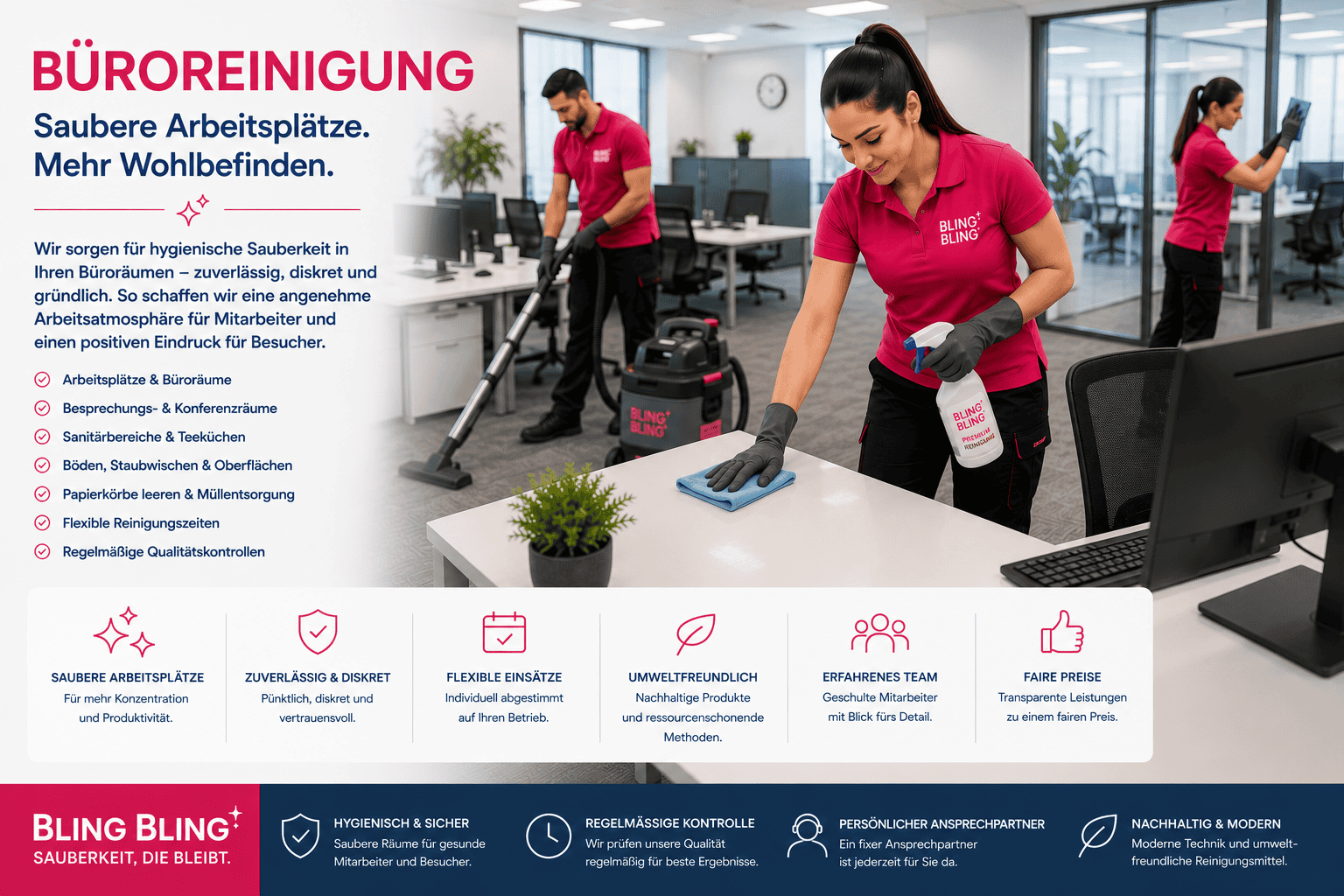
“Please clean the office once a week” – almost every dispute with a cleaning company starts with an instruction like that. What exactly gets cleaned, how often and to what standard is written down nowhere. The solution is a clear office cleaning specification. In this guide you will find out what an office cleaning specification is, why it saves money and nerves, which intervals have proved themselves in practice, how professionals clean an office step by step and which costs are realistic in Vienna, Graz, Linz and Salzburg.
What is an office cleaning specification?
The specification – often also called a cleaning schedule or scope of work – is the binding list of all cleaning services in a building. For each type of room it sets out:
- which surfaces and items are cleaned (for example desks, floors, door handles, sanitary fittings),
- by which method (spot cleaning, damp mopping, vacuuming, disinfection),
- at what interval (daily, 2 × a week, weekly, monthly, annually),
- when cleaning takes place (before work starts, during office hours, in the evening),
- and who supplies consumables such as soap, paper towels and bin bags.
It is based on the room groups and their floor areas in square metres. In Austria, service descriptions in building cleaning are often based on the ÖNORM D 2040 standard and, for quality control, on ÖNORM EN 13549 (cleaning services – basic requirements and recommendations for quality measuring systems). Information is available from the trade group for monument, façade and building cleaners at the Austrian Economic Chamber (WKO).
Why a clear specification pays off
- Comparable quotes: prices can only be compared fairly if every company prices the same specification. Without one, the quote that offers the least often wins.
- No arguments: once it is clear that window sills are cleaned monthly rather than weekly, there are no disputes about “forgotten” areas.
- Quality you can check: services that are defined can be inspected and documented.
- Cost control: setting intervals deliberately lets you save where cleaning is not needed and invest in the areas people see every day – reception, toilets, kitchen.
- Hygiene and health and safety: toilets and kitchenettes need different intervals and products from meeting rooms.
For tenders issued by property managers and larger companies, a specification is standard practice today. But small offices with five or ten workstations benefit too: even a single page listing rooms, services and intervals creates clarity for everyone involved – management, the team and the cleaners on site.
Template: cleaning intervals for a typical office
The following template has proved itself for offices with 10 to 80 workstations. It is a starting point – the final intervals depend on how the space is used, the number of visitors and the floor coverings.
| Area / service | Interval |
|---|---|
| Empty waste-paper bins, separate rubbish | daily or at every clean |
| Clean toilets, washbasins, taps and mirrors, refill consumables | daily |
| Kitchenette: worktops, sink, cupboard fronts, floor | daily |
| Reception, entrance, glass doors (fingerprints) | daily |
| Door handles, light switches, handrails (touch points) | 2 × a week to daily |
| Damp mop hard floors, vacuum carpets in work areas | 2 × a week to weekly |
| Damp wipe clear desk surfaces | weekly (tidy surfaces only) |
| Meeting rooms: tables, chairs, floor | after use, at least weekly |
| Window sills, radiators, doors, skirting boards | monthly |
| High-level dusting (tops of cupboards, lights, ventilation grilles) | quarterly |
| Windows and glass surfaces | 2 to 4 × a year |
| Deep cleaning of hard floors, carpet cleaning | 1 to 2 × a year |
When adapting the template, start with the rooms people use most and the areas visitors see first. An open-plan office with hot desking needs desks wiped more often than a set of single offices, while a meeting room used only once a week can safely be cleaned less often. If you are unsure, start with a slightly higher frequency and reduce it after the first few weeks once you can see where dirt really builds up.
How is an office cleaned professionally?
Professionals work to fixed rules: from top to bottom (high surfaces first, then desks, and the floor last), from clean to dirty (offices first, then the kitchenette, and toilets last) and from back to front (from the room furthest away towards the exit, so nothing is walked on again).
Routine cleaning step by step
- Walk-round and rubbish: empty waste-paper bins, separate recyclables, close windows, check the lights.
- Dusting from top to bottom: shelves, monitor edges (but not the screens themselves without permission), telephones, clear desk surfaces.
- Touch points: door handles, light switches and lift buttons with a separate cloth.
- Kitchenette: worktops, sink, cupboard fronts, the outside of the coffee machine, the fridge handle.
- Toilets and washrooms: always with dedicated, colour-coded cloths – red for toilets and urinals, yellow for washbasins and tiles. This stops germs being carried into the offices or kitchen.
- Floors: vacuum or damp mop from the furthest room towards the exit.
- Check and record: tick off the cleaning log, report defects and consumables that are running low.
Colour coding and products
The four-colour system (blue for offices and furniture, green for kitchens, yellow for washbasins, red for toilets) is standard in professional cleaning companies. For offices, pH-neutral maintenance cleaners are usually sufficient; in toilets and washrooms, acidic sanitary cleaners are used against limescale and urine scale. Disinfection is used selectively where it makes sense – for example in medical practices or during waves of illness – rather than across the board.
Worked example: how many hours does an office need?
To calculate prices, cleaning companies work with productivity rates in square metres per hour. For normal routine office cleaning these are often in the range of around 150 to 250 square metres per hour, depending on the furniture, the floor coverings and the scope of the work. Toilets and kitchenettes are assessed separately according to the number of fittings (toilets, washbasins, urinals), because they take considerably more time.
An example: an office of 300 square metres with two sets of toilets and a kitchenette, cleaned twice a week, needs about two to two and a half hours per clean. With eight to nine visits a month, that comes to around 17 to 22 hours a month. If the work areas are cleaned only once a week but the toilets and kitchen twice, the workload drops noticeably – without the areas you see every day suffering.
Quality control: keeping standards consistent
A specification is only as good as the way it is checked. Regular joint inspections have proved effective, for example monthly at the start and quarterly later on. Samples from all room groups are assessed according to a fixed scheme – which is exactly the basic idea behind ÖNORM EN 13549. A fixed contact person on both sides is important, so that feedback does not get lost in an inbox but actually reaches the team.

Fee from Bling Bling: My professional tip: ask every cleaning company to quote on the basis of the same specification. Only then can you see who is genuinely cheaper – and who simply cleans less.
You make the mess – we make it go away
How much does office cleaning cost? Price guidelines for 2026
Ongoing office cleaning is usually charged by the hour or as a flat monthly fee. Wages make up the bulk of the cost; in Austria they are based on the collective agreement (Kollektivvertrag, KV) for monument, façade and building cleaners, which is adjusted every year. The following figures are guideline prices, net, plus VAT.
| Service | Vienna | Graz | Linz | Salzburg |
|---|---|---|---|---|
| Ongoing routine cleaning (per hour, weekly schedule) | from €41.20 | from approx. €38 | from approx. €38 | from approx. €40 |
| Office of 150 m², 2 × a week (flat fee/month) | approx. €480–700 | approx. €450–650 | approx. €450–650 | approx. €480–720 |
| Office of 400 m², 5 × a week (flat fee/month) | approx. €2,200–3,200 | approx. €2,000–3,000 | approx. €2,000–3,000 | approx. €2,200–3,300 |
| One-off deep clean | from approx. €50 per hour or per m² | |||
The biggest cost drivers are daily intervals, a large number of toilets and washrooms, glass surfaces and cleaning during office hours. A well-thought-out specification can often cut costs by 15 to 25 per cent without any loss of visible quality. Find out more about what we offer under office cleaning in Vienna and routine cleaning in Vienna; for the annual big clean, we recommend our deep cleaning in Vienna.
How working with us works
During the site visit we record the rooms, floor areas and floor coverings and use them to draw up your office cleaning specification. You can see at a glance what is cleaned and when, and you can adjust the intervals at any time. Once we start, a regular team looks after your office, so you do not have to keep briefing new faces. Our customers rate us 4,8 stars on Google from 200 reviews.
Common office cleaning specification mistakes
- Tendering for “office cleaning” and nothing more: without room groups, areas and intervals, quotes cannot be compared.
- Everything daily: expensive and unnecessary. Meeting rooms that are rarely used do not need cleaning every day.
- Toilets cleaned too rarely: it saves a few euros but costs satisfaction and hygiene.
- Consumables not settled: who refills the soap and paper, who orders it and who pays?
- Planning around cluttered desks: cleaners should not move paperwork. Clear surfaces are cleaned – a clean desk policy helps.
- No inspections: without regular quality control, gaps creep in.
- Forgetting deep cleaning and window cleaning: routine cleaning alone will not keep floors and windows in good shape in the long run.
Checklist: office cleaning specification
- Room list with room groups and square metres drawn up
- Floor coverings recorded for each room (carpet, parquet, tiles, vinyl)
- Interval set for each service (daily to annually)
- Cleaning times fixed (before, during or after office hours)
- Separate interval for toilets and kitchenette
- Touch points explicitly listed
- Consumables and waste disposal arranged
- Handover of keys and alarm codes clarified
- Window cleaning, deep cleaning and carpet cleaning scheduled
- Quality control and contact persons agreed
- Clean desk policy agreed with the team
Frequently asked questions
What belongs in an office cleaning specification?
All rooms with their floor area and floor covering, the specific services for each room, the method, the interval and the cleaning time, plus arrangements for consumables, waste, keys and quality control.
How often should an office be cleaned?
Toilets, the kitchenette and reception usually daily, work areas once or twice a week, window sills and radiators monthly, windows two to four times a year and a deep clean once or twice a year.
How much does office cleaning cost per hour in Vienna?
For ongoing routine cleaning on a weekly schedule, from €41.20 net per hour. One-off jobs and deep cleans cost more, from around €50 net per hour.
Is there a standard for office cleaning in Austria?
Service descriptions are often based on ÖNORM D 2040 and quality control on ÖNORM EN 13549. What is binding, however, is what has been agreed in the contract and the specification.
Are desks cleaned as well?
Yes, clear desk surfaces are wiped with a damp cloth. Documents and personal items are not moved, for data protection and liability reasons.
What is the four-colour system?
A colour code for cloths and buckets: blue for offices, green for kitchens, yellow for washbasins and red for toilets. This prevents germs being carried from toilets into other areas.
Can the specification be changed later?
Yes. Intervals and services can be adjusted at any time, for example if the number of workstations changes or rooms are used differently.
How can I save money on office cleaning?
With intervals based on actual need rather than cleaning everything daily, a clean desk policy, cleaning outside office hours and a regular team that knows the building.
Request a free quote
Briefly describe your property – we will come back with a price and, if you wish, arrange a site visit for a fixed quote.