

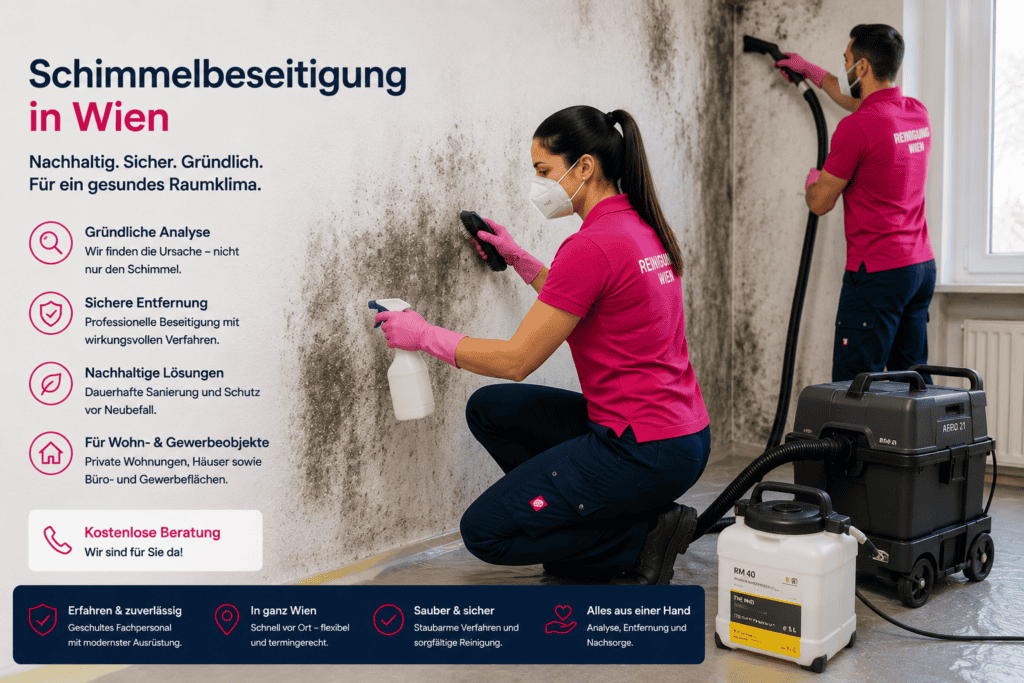
Black dots in the window reveal, a grey shadow behind the wardrobe, a musty smell in the bedroom: mould on walls is a constant issue in Austrian flats, especially during the heating season. This guide explains what mould actually is, why you should never simply paint over it, how it is removed properly, what it costs – and when it is better to call in professionals. You make the mess – we make it go away.
What is mould on walls?
Mould is not dirt in the usual sense but a living organism: mould fungi grow fine threads (mycelium) into plaster, wallpaper, silicone joints or wood and release spores into the air. Spores are everywhere – outdoors and indoors. They only become a problem when they find permanent moisture and food on a surface. Food comes from wallpaper paste, emulsion paint, house dust or wood; moisture is the real trigger.
In living spaces mould usually appears in typical places: in the corners of external walls, behind furniture placed directly against an external wall, on window reveals and roller-shutter boxes, on the ceiling above windows and, in bathrooms, on joints and shower curtains. The colour – black, grey, greenish or whitish – says little about how harmful it is. What matters is the size of the area, how deep it goes and the cause.
Mould or just dirt?
A simple test: dab the spot with a cotton bud and a little household bleach or methylated spirit. If the stain lightens immediately, it is very likely mould. Soot deposits (“fogging”), candle soot or dust trails above radiators look similar but behave differently and need a different type of cleaning. A musty, earthy smell is another strong indicator – even when nothing is visible yet.
Why does mould have to be removed?
Mould is more than a cosmetic problem. Spores and metabolic products get into the air you breathe every day. Health authorities therefore agree that mould indoors should not be tolerated – regardless of the species. People with allergies, asthma or a weakened immune system, older people and small children are particularly sensitive. Typical complaints are irritated airways, coughing, watery eyes or headaches.
Then there is the building fabric: mould destroys wallpaper and paint, grows into silicone joints, attacks wooden window frames and ruins the backs of furniture. The longer it grows, the deeper the mycelium penetrates – and a simple clean quickly turns into a renovation job with plaster removal.
Finally, there is the legal side: in rented flats the question of the cause comes up quickly – a building defect or the way the flat is used. Anyone who documents early (dated photos, humidity readings) and informs the landlord or property management promptly is in a much better position later. If necessary, clarify legal details with a tenants’ advice service or a lawyer; this guide is not legal advice.
Causes: why does mould grow exactly here?
Almost always the reason is too much moisture on a surface that is too cold. Warm room air can hold a lot of water vapour; when it meets a cold patch of wall it cools down and the vapour condenses. That spot stays permanently damp – the perfect breeding ground. A household of four releases many litres of water into the air every day through breathing, cooking, showering and drying laundry.
- Thermal bridges: external corners, concrete ceilings, roller-shutter boxes and window joints are colder than the rest of the wall.
- New, airtight windows in an old building without adjusted ventilation habits.
- Furniture against external walls with no air circulating behind it.
- Drying laundry indoors and airing too rarely.
- Structural causes: rising damp in the basement or ground floor, leaking roofs, burst pipes, flood damage.
A relative humidity of around 40 to 60 per cent is considered unproblematic in living spaces. If it stays above that for long periods, the risk rises sharply. A simple hygrometer costing a few euros shows you where you stand.
How is mould removed from walls properly?
Whether you can do it yourself depends on the size. Professional guidelines on mould remediation roughly follow this rule: superficial growth up to about half a square metre can be removed by healthy adults wearing protective equipment. Larger areas, deep growth in the plaster, recurring mould or mould after water damage belong in professional hands – as does any case where people with allergies, illnesses or children live in the household.
The right products
- Ethanol 70–80 % or isopropanol (pharmacy, drugstore): works well on smooth and mineral surfaces and evaporates without residue. Caution: flammable – no smoking, no open flames, ventilate well.
- Hydrogen peroxide 3 %: for mineral surfaces, with a slight bleaching effect.
- Chlorine-based mould sprays only sparingly and never together with other cleaners – they irritate the airways and only bleach the surface.
- Do not use vinegar on lime plaster: the acid reacts with the lime and the plaster loses its alkaline, mould-inhibiting effect.
Protective equipment
A particle-filtering mask (FFP2, better FFP3), tight-fitting safety goggles, disposable gloves and long-sleeved clothing that goes straight into the wash afterwards. Close doors to other rooms, open the windows.
Step by step
- Find the cause – otherwise the mould comes back. Measure humidity, check the wall for damp.
- Prepare the room: move furniture away, cover the floor beneath the area with plastic sheeting.
- Dampen the growth instead of brushing it off dry. A damp cloth binds spores.
- Work from the outside in: treat the edge of the visible growth first, then the centre, so you do not carry spores onto clean surfaces.
- Work from top to bottom: liquid that drips runs over areas already treated, not over clean ones.
- Let the product act, wipe it off with disposable cloths and put them straight into a sealable bag.
- Wallpaper and silicone: peel off affected wallpaper while damp, cut out affected silicone joints and reseal – cleaning alone is not enough here.
- Let it dry, then wipe the surrounding area damp and go over it with a HEPA vacuum.
- Repaint only once the wall is dry – ideally with a breathable silicate or lime paint.
The key principle is from clean to dirty: tools and cloths never go back from the affected area onto clean surfaces.
How we work together on mould removal
If the affected area is too large or the mould keeps coming back, our team takes over the professional mould removal. The process is clear:
- Enquiry: send us photos of the affected areas and, if available, a humidity reading.
- Inspection: we assess the area, the surface and the likely cause, on site if necessary. You receive a first price in writing beforehand.
- Fixed price: you then get a quote with a fixed price, including covering, protective measures and disposal.
- Start: our permanent team works with minimal dust, removes the growth, cleans the surrounding area and gives you concrete advice so that it does not return.
If the cause is structural – such as rising damp or a leaking pipe – we say so openly and recommend having it checked by a specialist before cleaning.
How much does it cost to have mould removed from walls?
The cost depends on the area, the surface, accessibility and whether plaster has to be removed. The following figures are non-binding guide prices for superficial mould removal by a specialist company, net, excluding structural repairs:
| City | Small area (up to approx. 0.5 m²) | Medium area (up to approx. 5 m²) | Larger areas |
|---|---|---|---|
| Vienna | approx. €150–350 | approx. €350–900 | from approx. €40/m² |
| Graz | approx. €140–330 | approx. €330–850 | from approx. €38/m² |
| Linz | approx. €140–330 | approx. €330–850 | from approx. €38/m² |
| Salzburg | approx. €160–370 | approx. €370–950 | from approx. €42/m² |
Guide prices as of November 2026, depending on effort and travel. At Bling Bling Premium Reinigung one-off jobs are charged from €50 net per hour plus travel, or as a flat rate. You receive the binding fixed price after photos or an inspection.
It becomes more expensive if plaster has to be knocked off, drying equipment set up or causes such as leaking pipes repaired – these are construction services that are calculated separately.
Common mistakes when removing mould
- Painting over it: paint only hides mould visually. The mycelium keeps growing underneath and shows through again after a few weeks.
- Brushing or vacuuming dry without a HEPA filter: spreads millions of spores through the flat.
- Vinegar on lime plaster: neutralises the plaster and creates new areas for attack.
- Mixing products: never combine chlorine cleaners with acidic cleaners – toxic gases can form.
- Treating the surface, not the cause: without more airing, more even heating or fixing the structural damage, the mould will soon be back.
- Turning the heating down to save money: cold rooms increase the relative humidity at the walls.
- Tilted windows instead of short, intensive airing: the reveal cools down and the air exchange stays low.
Checklist: removing and preventing mould
- Photograph the growth, note the date, estimate the area
- Measure humidity with a hygrometer (target approx. 40–60 %)
- Inform the landlord or property management (rented flats)
- Under 0.5 m² and superficial? Otherwise hire a specialist
- Have an FFP2/FFP3 mask, goggles and gloves ready
- Cover the floor, close doors, open windows
- Treat the growth damp – outside in, top to bottom
- Dispose of disposable cloths immediately in a sealed bag
- Replace affected silicone joints and wallpaper
- Let the wall dry completely, then use breathable paint
- Air the room intensively three to four times a day for 5–10 minutes
- Place furniture a few centimetres away from external walls
Frequently asked questions
Can I remove mould from the wall myself?
For superficial growth up to about half a square metre, yes – with a protective mask, gloves, goggles and a suitable product such as 70–80 % alcohol. For larger areas, deep growth or allergy sufferers in the household, a specialist company should take over.
Does vinegar help against mould?
Not on lime plaster and mineral surfaces. The acid reacts with the lime and the surface loses its mould-inhibiting effect. Ethanol, isopropanol or hydrogen peroxide are better suited.
Is it enough to paint over mould?
No. The fungal network keeps growing under the paint and reappears. The growth must first be removed and the wall dried.
Why does the mould keep coming back?
Because the cause has not been eliminated – usually excessive humidity on cold wall areas or structural moisture damage. Measure the humidity and have recurring mould checked by a professional.
What should the humidity be in a flat?
Around 40 to 60 per cent relative humidity is considered good in living spaces. Permanently higher values, especially in bedrooms and bathrooms, encourage mould.
How much does professional mould removal cost in Vienna?
For small areas the guide price is around €150 to €350 net, for medium areas up to approx. €900. You receive the fixed price after photos or an inspection.
Is mould on walls harmful to health?
Indoor mould is generally considered a health concern, especially for people with allergies or asthma, children and people with weakened immune systems. It should therefore be removed quickly and properly.
Which mask do I need when removing mould?
A particle-filtering mask of class FFP2, or better FFP3 for larger jobs. A simple surgical mask is not enough.
Mould on your walls? We will take care of it.
Send us a few photos – you receive a written price indication and a fixed price after the inspection. Read more about our service on the page mould removal Vienna; after remediation we can also take care of a flat deep cleaning or a disinfection cleaning.
Customer rating: 4,8 out of 5 stars from 199 Google reviews
You make the mess – we make it go away.