
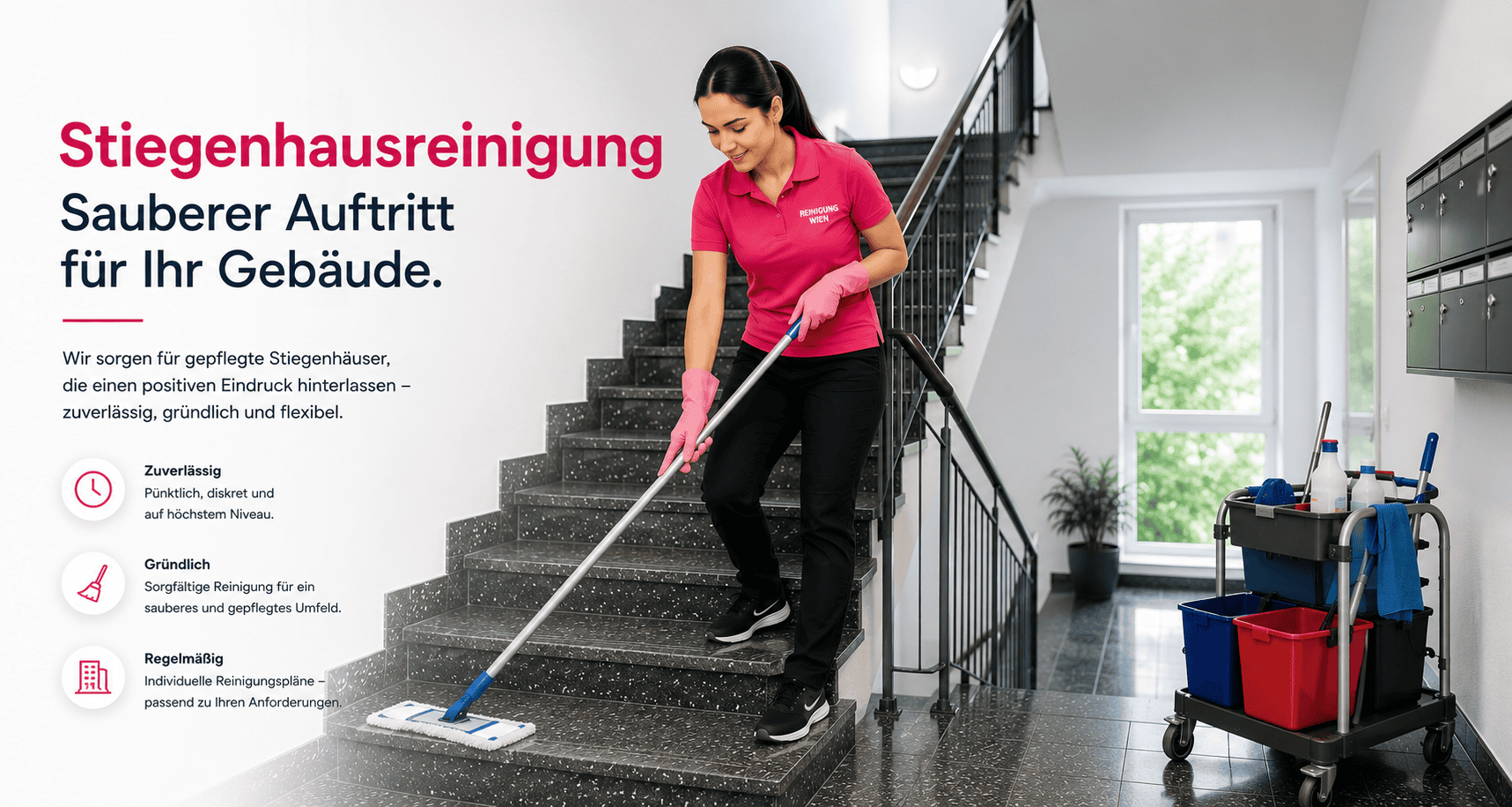
The stairwell is the calling card of every residential building. Within seconds, tenants, owners, visitors and prospective buyers decide whether a building looks well kept or neglected. In this guide to stairwell cleaning we explain, without beating about the bush, what a professional job involves, the order in which professionals work, how often a stairwell should be cleaned, which costs are realistic in Vienna, Graz, Linz and Salzburg, and who ultimately pays for it.
What is stairwell cleaning?
Stairwell cleaning means the regular cleaning of all communal areas of a multi-occupancy building: stairs and landings, handrails and banisters, the main entrance and front door, the letterbox unit, the lift (car, doors, control panels), stairwell windows, light switches, the stairs down to the cellar and, depending on the agreement, the bin room, bike store and laundry room as well.
Professionals distinguish between three levels:
- Routine cleaning: the ongoing, usually weekly clean – sweeping, damp mopping, wiping handrails and touch points, cleaning the entrance area.
- Periodic cleaning: at longer intervals, for example monthly or quarterly – doors and frames, radiators, window sills, skirting boards, cobwebs on ceilings.
- Deep cleaning: once or twice a year – machine cleaning of the floors, stripping old polish layers, applying a fresh protective finish to stone or vinyl floors, cleaning light fittings and glass surfaces.
This distinction matters because it directly determines both price and result: a building that is only ever mopped but never deep cleaned will look grey and blotchy after two or three years, despite weekly cleaning.
Why is regular stairwell cleaning so important?
It is about far more than appearance. A well-kept stairwell has tangible benefits:
- Safety: leaves, grit, moisture and films of dirt on the stairs are among the most common causes of falls in residential buildings. In winter especially, residents carry slush and salt right up to the top floors.
- Hygiene: handrails, door handles, lift buttons and light switches are touched by dozens of hands every day. Cleaning them regularly noticeably reduces the germ load.
- Preserving value: limestone, terrazzo, marble and artificial stone in older buildings are delicate. Sand acts like sandpaper, and the wrong cleaning products attack stone surfaces. Proper care prevents expensive restoration work.
- Peace in the building: few topics cause as much friction among neighbours as a dirty stairwell. A clear, professional arrangement takes the heat out of the discussion.
- Letting and selling: prospective tenants and buyers walk through the stairwell first. That first impression shapes how they judge the condition of the whole building.
How often should a stairwell be cleaned?
There is no legal minimum frequency. In practice, the following rule of thumb has proved itself:
| Type of building | Routine cleaning | Deep cleaning |
|---|---|---|
| Small building, up to approx. 8 households | 1 × a week | 1 × a year |
| Medium-sized building, 9 to 25 households | 1 to 2 × a week | 1 to 2 × a year |
| Large residential complex, lift, heavy foot traffic | 2 to 3 × a week | 2 × a year |
| Mixed-use building (medical practice, offices) | 2 to 5 × a week | 2 × a year |
In winter, during building work or when people are moving in or out, an additional one-off clean makes sense. A good indicator: if residents are already seeing crumbs, sand and footprints on the landings by Monday, the frequency is too low.
The type of building plays a role, too. A period building with stone stairs, a large entrance hall and many stairwell windows needs more attention than a compact new build with a lift and tiled floors. Buildings with a ground-floor shop, a doctor’s surgery or a short-term let generate noticeably more foot traffic, and the cleaning schedule should reflect that rather than follow a standard template.
How is a stairwell cleaned properly?
Professionals work to two basic rules: from top to bottom and from clean to dirty. Dirt falls downwards, so you start on the top floor and work your way down to the main entrance. The entrance area, where most of the dirt collects, comes last.
Routine cleaning step by step
- Preparation: put up a “slippery floor” warning sign in the entrance area; do not move residents’ doormats around, just push them to the side.
- Dry pre-clean: sweep or vacuum the stairs and landings from top to bottom. In older buildings with stone stairs this is essential, so that sand does not cause scratches during mopping.
- Touch points: wipe handrails, banisters, door handles, light switches, lift buttons and letterboxes with a pH-neutral cleaner and a microfibre cloth. A separate, colour-coded cloth is used for each area.
- Damp mopping: mop the stairs and landings using the two-bucket method (a mop with separate dirty and clean water), again from top to bottom. Do not use too much water, so it does not soak into joints and the base of the walls.
- Lift: clean the car floor, walls, mirror and stainless steel surfaces, and vacuum the door tracks.
- Entrance area: clean the front door inside and out, including the glass, vacuum or shake out the entrance mat, and mop the floor thoroughly.
- Final check: walk round looking at corners, stair nosings and cobwebs, and only remove the warning sign once the floor is dry.
Which cleaning products for which floors?
- Natural stone (marble, limestone, terrazzo): only pH-neutral or mildly alkaline stone care products. Vinegar, citrus cleaners and descalers permanently damage the surface.
- Porcelain stoneware and tiles: a neutral cleaner for routine care, with an occasional alkaline deep cleaner to tackle greasy films.
- Vinyl and linoleum: wipe-care products with conditioning additives; during the deep clean the old protective film is stripped and a new one applied.
- Wooden stairs: mop with a barely damp mop, never wet, using a product suited to the finish (oiled or sealed).
If you would like more detail on storing cleaning products correctly and which ones must never be mixed, see our guide Using cleaning products safely. How to relieve the entrance zone in winter with barrier matting is explained in our article Keeping the entrance clean in winter.
What a good cleaning specification for the stairwell contains
Whether you manage a building or own a flat in it, a written specification is the best protection against misunderstandings. It should list every area to be cleaned, the method, the frequency and which tasks are routine, periodic or part of the annual deep clean. Stairwell windows, the lift, the cellar stairs, the bin room and the bike store are worth naming explicitly, because these are the areas most often left out of vague agreements. A fixed contact person and a simple way of reporting problems complete the picture.

Fee from Bling Bling: My professional tip for property managers: ask for the cleaning specification in writing – with frequency, areas and the date of the deep clean. Then everyone in the building knows what gets done and when, and arguments on the landing become a thing of the past.
You make the mess – we make it go away
Who pays for stairwell cleaning?
In Austria, the cost of cleaning the communal parts of a building is generally classed as an operating cost. Where the Austrian Tenancy Act (Mietrechtsgesetz, MRG) applies in full, it falls under caretaking costs (§ 23 MRG), which may be passed on to tenants proportionately through the annual service charge statement (§ 21 MRG). In owner-occupied buildings (Wohnungseigentum), the costs are split among the owners according to the agreed apportionment key and settled by the property manager.
Points that matter in practice:
- Only costs that were actually incurred and are reasonable may be passed on. Tenants have the right to inspect the receipts.
- Repairs and restoration (for example grinding down a damaged stone floor) count as maintenance work, not cleaning costs.
- For tenancies outside the full scope of the MRG, whatever was agreed in the tenancy agreement applies.
The legal basis can be found in the Austrian federal legal information system: Tenancy Act (MRG) in the RIS. For individual cases, the tenants’ association (Mietervereinigung), the Chamber of Labour (Arbeiterkammer) or a lawyer can advise.
How much does stairwell cleaning cost? Price guidelines for 2026
The cost depends on the number of floors, whether there is a lift, the type of flooring, the frequency and any extra services. Ongoing stairwell cleaning is usually charged as a flat monthly fee, while one-off deep cleans are billed by time or by floor area. All figures are guideline prices, net, plus VAT.
| Service | Vienna | Graz | Linz | Salzburg |
|---|---|---|---|---|
| Small building, 1 × a week (flat fee/month) | €140–220 | €130–200 | €130–200 | €150–230 |
| Medium-sized building with lift, 1 × a week | €240–420 | €220–380 | €220–380 | €250–430 |
| Large complex, 2 × a week | from €450 | from €420 | from €420 | from €470 |
| One-off deep clean | from approx. €50 per hour or per m², depending on floor and condition | |||
The differences between the cities come mainly from travel and the building stock: Vienna’s late 19th-century Gründerzeit buildings, with high ceilings, lots of stairwell windows and stone stairs, take more time than a new build with porcelain tiles. You receive a binding fixed price after a site visit. Details of our service can be found on our stairwell cleaning in Vienna page; if you would also like green areas, bins and winter gritting covered, our caretaking services in Vienna are the right fit.
How working with us works
Once we start, your building gets a regular team that knows the particular features of the property. Changes in frequency, extra requests or one-off cleans after a move are arranged easily through a single, fixed contact person. Our customers rate us 4,8 stars on Google from 200 reviews.
Common stairwell cleaning mistakes
- Wet mopping without sweeping first: the sand is spread into a grey sludge and scratches stone stairs.
- Working from the bottom up: dirt from above falls onto areas that have already been cleaned.
- One bucket of water for the whole building: after two floors you are just spreading dirt around. Professionals change the water regularly or work with pre-soaked mops.
- Acidic cleaners on marble and terrazzo: they leave dull, rough patches that can only be removed by grinding.
- Too much floor care product: the floor becomes sticky and attracts dirt. Less is more.
- Forgetting the handrails: visually inconspicuous, but in terms of hygiene the most important surface in the building.
- No deep cleaning: if a floor is only ever mopped, layers build up over the years and make the stairwell look permanently grey.
Stairwell cleaning checklist
- Stairs and landings swept or vacuumed, from top to bottom
- Stairs and landings damp mopped, stair nosings clean
- Handrails, banisters and balusters wiped down
- Door handles, light switches, doorbell and lift buttons cleaned
- Letterbox unit and noticeboard wiped
- Lift: floor, walls, mirror, door tracks
- Front door and glass cleaned inside and out
- Entrance mat vacuumed or shaken out
- Cobwebs removed from ceilings and corners (monthly)
- Window sills, radiators, skirting boards (monthly)
- Stairwell windows (as agreed, usually 2 to 4 × a year)
- Deep clean and fresh protective finish (annually)
Frequently asked questions
How often does a stairwell need to be cleaned?
There is no legally required frequency. Weekly routine cleaning is usual for smaller buildings, and two to three cleans a week for large complexes with a lift, supplemented by an annual deep clean.
Can the cost of stairwell cleaning be passed on to tenants?
Where the Austrian Tenancy Act (MRG) applies in full, yes: cleaning the communal areas counts as a caretaking cost under § 23 MRG and is charged proportionately through the service charges. Outside the MRG, the tenancy agreement applies.
How much does stairwell cleaning cost per month in Vienna?
For a small building cleaned weekly, guideline prices are around €140 to €220 net per month, and around €240 to €420 for medium-sized buildings with a lift. You receive a fixed price after a site visit.
Which cleaning product is suitable for stone stairs in an older building?
A pH-neutral stone cleaner or stone soap. Acidic products such as vinegar or descalers attack marble, limestone and terrazzo and leave dull patches.
Why do you clean from top to bottom?
Because dirt and water travel downwards. Starting at the top means you do not soil areas you have already cleaned, and you deal with the heaviest dirt in the entrance area last.
Is cleaning the stairwell windows included?
That depends on the agreement. Stairwell windows are usually cleaned two to four times a year and included separately in the flat fee.
Do tenants have to clean the stairwell themselves?
Only if this has been validly agreed in the tenancy agreement or the house rules. In most multi-occupancy buildings today, cleaning is handled by a cleaning company or caretaking service.
How quickly can stairwell cleaning start?
After your enquiry and a site visit, you receive a fixed-price quote. Once you place the order, we usually start within a few days with a regular team.
Request a free quote
Briefly describe your property – we will come back with a price and, if you wish, arrange a site visit for a fixed quote.